
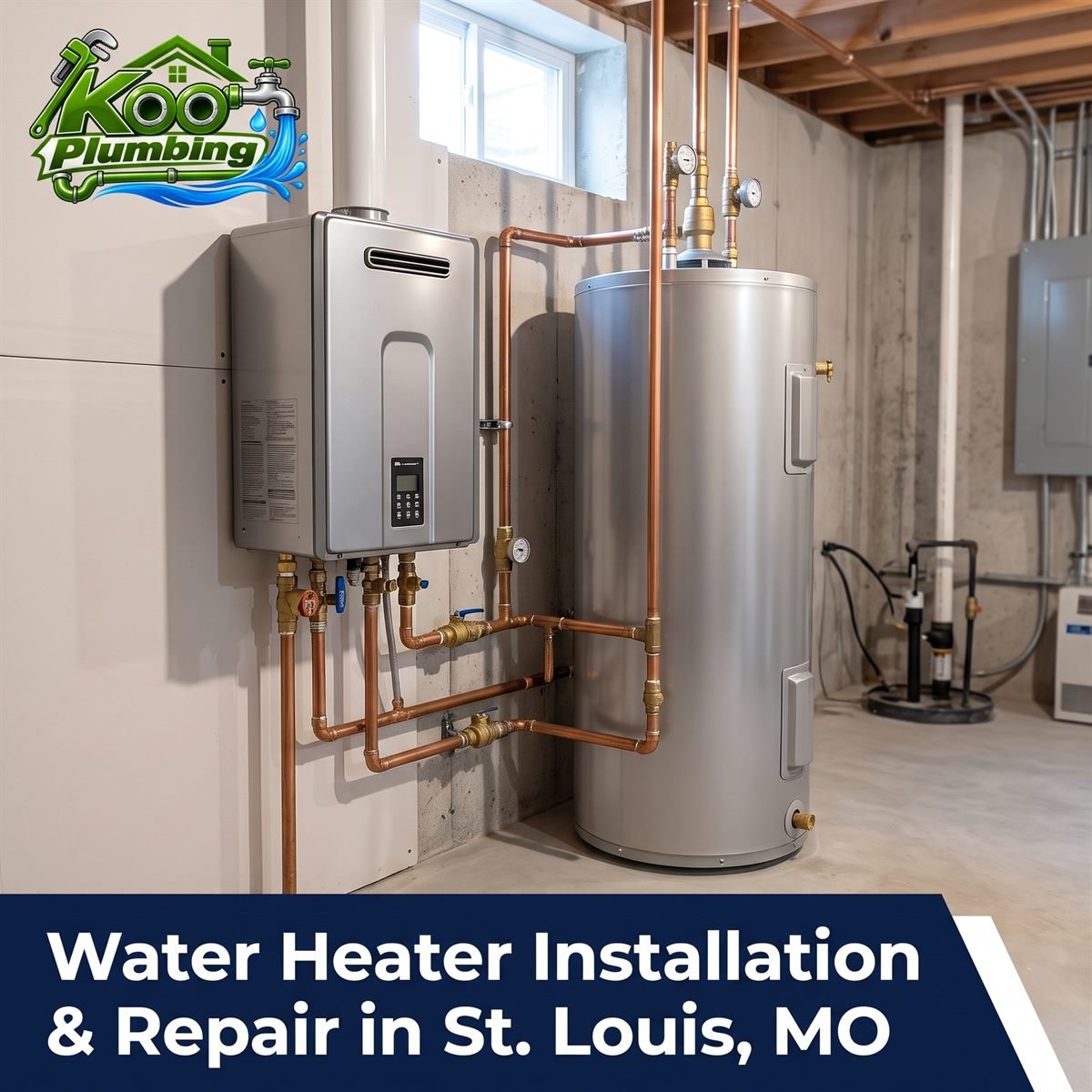
Water Heater Installation & Repair in St. Louis, Fast
If your water heater is under about 8 years old and the problem is a part (a thermocouple, igniter, element or thermostat), repair usually makes sense. If the tank itself is leaking or it's past 10 years, replacement is the safer buy. Either way, call +1 314 648 0564 to reach a licensed local plumber, day or night.
St. Louis winters make water heaters work harder: the water coming into your home is much colder in January than in July, so the burner or elements run longer. Through Koo Plumbing, you're connected with a licensed 24/7 plumber in St. Louis, MO who repairs and installs gas and electric tank heaters and tankless units across St. Louis City and County.
- Cut the power or gas: For an electric heater, switch off its breaker. For gas, turn the control knob to OFF.
- Close the cold water valve: It's on the pipe going into the top of the tank. Turn it clockwise until it stops.
- Keep people back: Water from the tank can be scalding, and don't touch electrical equipment standing in water.
- Smell gas? Leave the house and call Spire's gas emergency line or 911 from outside before anything else.
Water Heater Services
Licensed contractors in our network handle gas, electric and tankless systems:
- Emergency Water Heater Diagnostics & Repairs: Fast troubleshooting for pilot light outages, malfunctioning thermocouples, faulty electronic igniters, damaged heating elements, and broken thermostats.
- Tankless Water Heater Installation & Conversions: Upgrade from bulky storage tanks to compact, wall-mounted tankless units that deliver endless on-demand hot water while significantly reducing monthly utility bills.
- Traditional Storage Tank Replacements: Expert sizing and installation of 30, 40, 50, and 75-gallon atmospheric gas, power-vent, and electric storage water heaters from top manufacturers like Bradford White, Rheem, and A.O. Smith.
- Thermal Expansion Tank Installation: Essential for closed-loop plumbing systems to absorb increased water pressure caused by thermal expansion, protecting your pipes and extending tank longevity.
- Temperature and Pressure (T&P) Relief Valve Servicing: Testing, repairing, and replacing vital safety relief valves to prevent dangerous over-pressurization inside water heater tanks.
- Sediment Flushing & Descaling: Routine preventative maintenance to clear mineral deposits and scale caused by St. Louis hard water, improving heating efficiency and preventing tank corrosion.
- Anode Rod Inspection & Replacement: Checking and replacing the sacrificial magnesium or aluminum anode rod, which slows interior rust and can extend the life of the tank.
- Water Leaking Around the Base: Pooling water near the bottom of your tank indicates internal vessel corrosion or faulty drain valves requiring immediate evaluation.
- Popping or Rumbling Noises: Loud knocking sounds occur when water boils beneath a thick layer of sediment trapped at the bottom of the tank.
- Rusty or Discolored Water: Brownish or metallic-smelling hot water indicates severe internal rust or a decaying sacrificial anode rod.
- Sudden Loss of Hot Water: Experiencing lukewarm showers or rapid hot water depletion indicates burned-out elements or a fractured dip tube.
- Rotten Egg or Sulfur Odor: Bacteria reacting with anode rods inside the tank can generate hydrogen sulfide gas, requiring professional disinfection and rod replacement.
Tankless vs. Traditional Tank Water Heaters: Which Is Right for You?
When replacing an aging water heater, choosing between a traditional storage tank and a modern tankless system is a major decision for St. Louis property owners:
Efficiency and lifespan figures for tankless units come from the U.S. Department of Energy's guide to tankless water heaters. Our take: tankless pays off most for households that run out of hot water or plan to stay in the home for many years. If your current tank simply wore out and hot water was never a problem, a new tank is usually the more cost-effective choice.
Why Proper Water Heater Installation Matters in St. Louis
Installing a water heater is not a simple DIY job. Building codes across St. Louis County, Clayton, Chesterfield and Kirkwood set rules for flue venting, combustion air, gas pipe sizing and, where required, seismic strapping, and replacement usually needs a permit and inspection that your contractor handles. Improper gas connections can cause dangerous carbon monoxide leaks, while incorrectly configured pressure relief lines can cause catastrophic tank ruptures.
Furthermore, high-pressure closed plumbing loops in modern homes require code-mandated thermal expansion tanks. If you also suspect water loss or concealed foundation moisture around your utility room, our network also provides specialized leak detection and slab leak repair services to safeguard your property. You may also want to inspect your bathroom and kitchen taps through our faucet, sink, and shower plumbing specialists to ensure pressure valves and cartridges operate in harmony.
Frequently Asked Questions About Water Heaters
In the St. Louis area, traditional tank water heaters typically last between 8 and 12 years due to mineral content and seasonal temperature fluctuations. Tankless systems can last 20 years or more with annual descaling maintenance.
Most St. Louis homes can accommodate a tankless system. A contractor will verify your gas supply line capacity (or electrical panel if electric) and ensure proper direct-vent exhaust routing to satisfy local Missouri building codes.
In most of St. Louis City and County, yes: replacing a water heater usually requires a plumbing permit and inspection, especially for gas units. The licensed contractor pulls the permit for your city or the county. Permitted work also matters if you ever file an insurance claim or sell the house.
Sediment has settled at the bottom of the tank, and water trapped under it boils and pops as the burner heats. Flushing the tank often quiets it down. If the tank is old and the noise comes with rusty water or leaks, it is usually time to replace it.